Alka Melt Drops Official Website › Blog › Gotu Kola: Two Literatures, Two Doses
Gotu Kola: Two Literatures, Two Different Doses
Gotu Kola Extract is the first name on this pack sheet’s list of seven, and it is also the one botanical here with two entirely separate clinical trial records attached to it — one in circulation, one in cognition, running at two doses that are nowhere near each other. Reading only one of the two tells half the story.
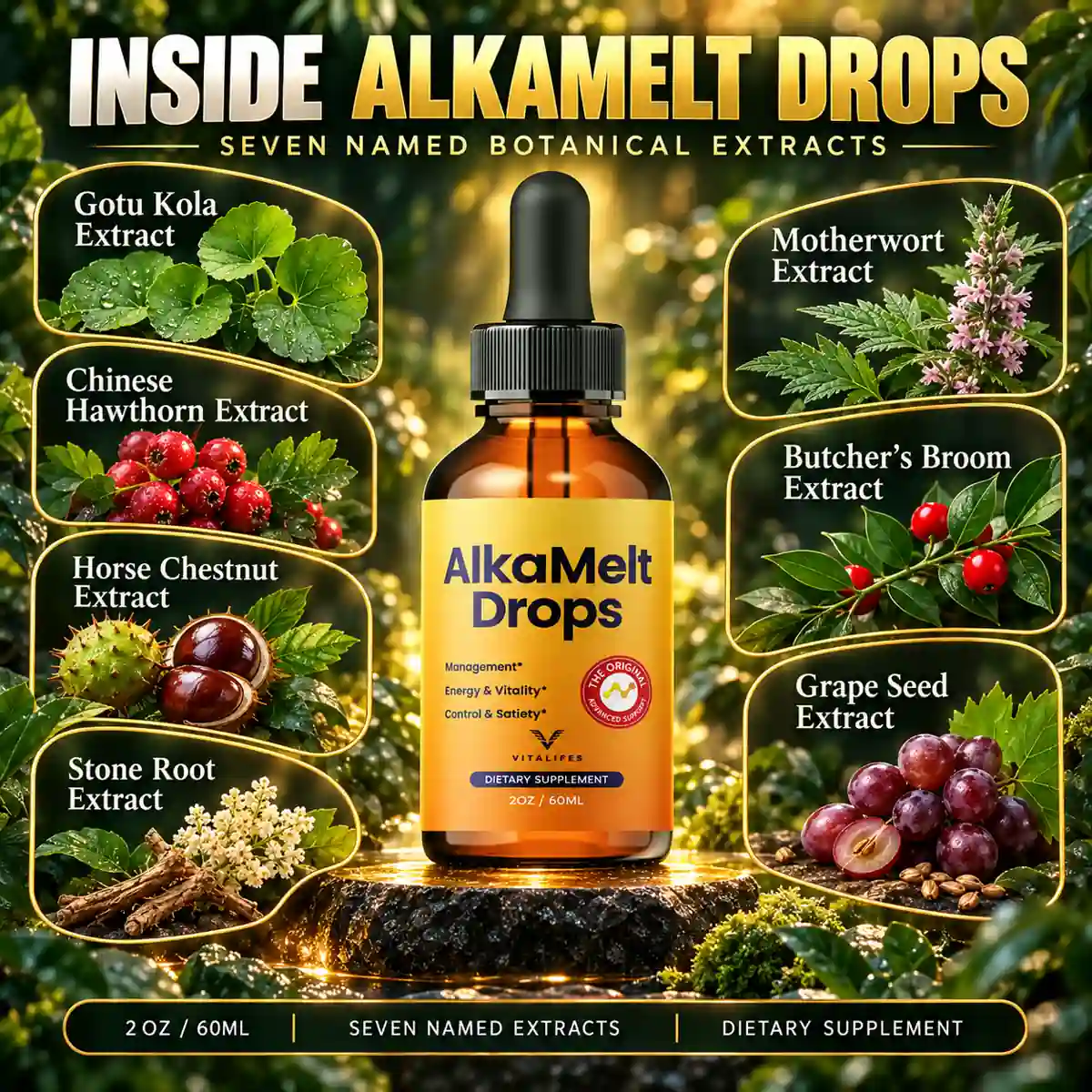
- This pack sheet names Gotu Kola Extract (leaf) with no weight given.
- Its venous-circulation trials, including a Cochrane-reviewed double-blind study, ran a titrated extract at 60-120 mg/day, standardised on asiaticoside and two related acids.
- A separate 2017 meta-analysis pooled trials of mood and cognitive outcomes, a different population and a different dose picture, and found the results mixed.
- A 2013 systematic review of gotu kola specifically for chronic venous insufficiency reached a cautious verdict: promising, but the trial base is still small.
- Nothing in either literature measured appetite, energy or body weight.
What this pack sheet actually names
The retail pack sheet for this product lists “Gotu Kola Extract (leaf)” first among its seven named botanicals. Gotu kola is the common name for Centella asiatica, a small creeping plant in the parsley family found across wetland and marsh margins in South and Southeast Asia, where it has a documented history in Ayurvedic and traditional Chinese medicine reaching back centuries. The part named here, leaf, is also the part every clinical trial below actually used — which is not something every name on this sheet can say.
What the sheet does not give is a weight. No milligram figure appears beside gotu kola’s name, and no standardisation marker is printed either. That absence is the reason this page exists: without a number to check, the only honest comparison available is the ingredient’s own trial record, read in full, against the raw fact that this bottle’s dropper carries no declared amount.
The venous dose: 60-120 mg/day, and where it comes from
Gotu kola’s clinical record sits mostly in venous circulation research, alongside horse chestnut, butcher’s broom and grape seed as one of the standard phlebotonic botanicals. The 2020 Cochrane review of phlebotonics for venous insufficiency groups a titrated Centella asiatica extract with the other venoactive agents it assesses, citing trial data using extracts standardised to 60 to 120 milligrams a day.
The trial most often cited for that figure is older and more specific. A 1994 double-blind study published in Minerva Cardioangiologica measured microcirculation directly in people with venous insufficiency, using a titrated extract of Centella asiatica standardised on its three principal triterpenes: asiaticoside, asiatic acid and madecassic acid. That standardisation detail matters as much as the milligram figure, because “gotu kola extract” without a standardisation marker could in principle carry a very different ratio of those three compounds.
A second, related trial adds a specific instrument to the picture. A 2001 study in Angiology tested the total triterpenic fraction of Centella asiatica in people with chronic venous hypertension, measuring microcirculatory changes with laser Doppler flowmetry, transcutaneous oxygen and carbon dioxide tension, and leg volumetry — three separate instrumented readings rather than a symptom questionnaire alone. That combination of hard measurements is one of the reasons gotu kola’s venous evidence is taken seriously beyond self-reported comfort scores.
| Trial | Dose | What was measured |
|---|---|---|
| Cesarone et al., 1994 (Minerva Cardioangiologica) | Titrated extract, standardised on asiaticoside, asiatic acid, madecassic acid | Microcirculation in venous insufficiency, double-blind vs placebo |
| Cesarone et al., 2001 (Angiology) | Total triterpenic fraction | Laser Doppler flow, transcutaneous gas tension, leg volumetry |
| Cochrane phlebotonics review, 2020 | Titrated extract, 60-120 mg/day (pooled description) | Grouped with other venoactive agents across the review |
Every figure in this table describes a standardised, titrated extract. None of it describes a plain “gotu kola extract” with no marker attached.
A systematic review built specifically around this question
Beyond the individual trials, a 2013 paper asked the broader question directly: does the published record, taken as a whole, actually support gotu kola for chronic venous insufficiency? That systematic review, published in Evidence-Based Complementary and Alternative Medicine, pooled the available randomised and controlled trials and reached a measured conclusion: the existing evidence suggests gotu kola can improve the signs and symptoms of chronic venous insufficiency, but the number and size of the trials available were still limited enough that the authors called for larger, better-designed studies before the case could be considered settled.
That is a useful sentence to hold onto, because it is neither a dismissal nor an endorsement without qualification. It describes exactly the kind of evidence this desk tries to represent honestly throughout this website: real, positive, methodologically reasonable, and still short of the scale that would make it definitive. A reader who wants the single most balanced verdict on gotu kola and venous circulation could do worse than start with that 2013 review before working through the individual trials above it.
Read the Alka Melt Drops research beside every name
Seven botanicals on the retail pack sheet, four more on the seller’s artwork, and the dose or species gap each one’s trials carry printed next to it. A 2 fl oz / 60 mL amber glass dropper bottle, with the pack price at the seller’s checkout.
Price at checkout · one-time payment · money-back guarantee as printed on the listing
Order Alka Melt Drops On The Official Website2 fl oz / 60 mL amber glass dropper bottle · lot ALK-26/TH-2256
The second literature: mood and cognitive outcomes
Gotu kola does not stop at the venous literature, and a reader who assumes it does will miss a genuinely separate body of research. A 2017 systematic review and meta-analysis in Scientific Reports pooled trials of Centella asiatica’s effects on cognitive function and mood-related outcomes — memory, attention, anxiety and related measures, tested in different populations, at different doses, using different preparations than the venous studies above.
The finding was mixed rather than clearly positive. The authors reported some signal favouring Centella asiatica on select cognitive and mood measures, but flagged real limitations: the pooled trials were heterogeneous in dose, preparation and outcome measure, several individual studies were small, and the authors were explicit that the evidence was not strong enough to draw a firm conclusion in either direction. That is a meaningfully different verdict from the venous literature’s cautiously positive one, and it is worth being precise about why the two do not simply add together into one larger case for the plant.
The venous trials and the cognition trials were not run on the same extract at the same dose. The 60-120 mg/day figure belongs specifically to the triterpene-standardised extracts used in the microcirculation studies. The cognition literature covers a range of doses and preparations across its pooled trials, several considerably higher, and standardised (where standardised at all) to different markers. Citing the cognition meta-analysis to support a circulation claim, or the venous dose to support a cognitive one, borrows a number from the wrong study.
Why one plant carries two research questions
It helps to understand why gotu kola ended up with two separate literatures rather than one unified one. Traditional use of Centella asiatica in Ayurveda and Southeast Asian folk medicine covers both wound-healing and circulatory complaints on one hand, and cognitive or nervine tonic use (the plant is sometimes called “brahmi,” though that name is also used for a different plant, Bacopa monnieri, which adds its own layer of labelling confusion elsewhere in the supplement aisle) on the other. Modern researchers picked up both threads independently, decades apart, and tested them against the outcomes each tradition actually claimed.
The result is a plant with real, separately-earned evidence in two different domains, standardised to different markers, tested at different doses, in different populations. That is not a flaw in the plant. It is a reason to ask, every time gotu kola’s name is invoked in support of a claim, which of its two literatures the claim is actually drawing on — and whether the dose implied by that claim matches the dose the relevant trials used.
Standardisation: the marker that makes a dose comparable
Every venous trial cited above shares one feature beyond its dose range: the extract was standardised to a defined percentage of triterpenes, principally asiaticoside, asiatic acid and madecassic acid, sometimes summarised as total triterpenic fraction or TTFCA. Without that standardisation, a milligram figure alone says very little, because two extracts both labelled “gotu kola, 100 mg” can carry substantially different amounts of the compounds the trials actually measured.
This is the same principle this website applies to horse chestnut’s aescin marker and hawthorn’s procyanidin marker elsewhere on this blog: a weight without a standardisation percentage is a partial answer, useful mainly for ruling out an obviously trivial amount, not for confirming a trial-matching one.
Reading a gotu kola row on any label
Three questions, and each takes a moment.
- Which claim is it attached to? A circulation claim should point to the 60-120 mg/day triterpene-standardised literature. A cognition or mood claim should point to the 2017 meta-analysis, and should be read with that review’s own caution about mixed results attached.
- Is a standardisation marker given? Look for asiaticosides, triterpenes or TTFCA with a stated percentage. Without it, the milligram figure alone cannot be matched to a specific trial.
- Does the amount land in or near 60-120 mg/day? That is the range behind the venous trials specifically, not a general-purpose gotu kola dose.
This desk applies a near-identical standardisation-and-dose check to horse chestnut and to Chinese hawthorn. Gotu kola is the one case on this list where the check has to be run twice, once per literature, before it means anything.
What that means for this bottle
This pack sheet names gotu kola leaf with no weight and no standardisation marker. That leaves both of the questions above open: there is no figure to compare against the venous trials’ 60-120 mg/day, and no figure to compare against the wider dose range the cognition meta-analysis pooled. Naming the leaf, rather than root or whole plant, is a small point in the sheet’s favour, since leaf is the part every trial cited here actually used.
What this desk can say honestly is this: gotu kola carries two real, separately-evidenced literatures, neither one settled beyond a cautious “promising, more research needed” verdict, and this bottle’s dropper gives no way to check which dose, if either, it is delivering. This site’s ingredients page prints both dose ranges side by side for exactly this reason.
References
- Martinez-Zapata MJ, Vernooij RW, Simancas-Racines D, et al. Phlebotonics for venous insufficiency. Cochrane Database Syst Rev. 2020;11(11):CD003229. PMID 33141449. https://pubmed.ncbi.nlm.nih.gov/33141449/
- Cesarone MR, Laurora G, De Sanctis MT, et al. The microcirculatory activity of Centella asiatica in venous insufficiency. A double-blind study. Minerva Cardioangiol. 1994;42(6):299-304. PMID 7936334. https://pubmed.ncbi.nlm.nih.gov/7936334/
- Cesarone MR, Belcaro G, Rulo A, et al. Microcirculatory effects of total triterpenic fraction of Centella asiatica in chronic venous hypertension: measurement by laser Doppler, TcPO2-CO2, and leg volumetry. Angiology. 2001;52 Suppl 2:S45-8. PMID 11666123. https://pubmed.ncbi.nlm.nih.gov/11666123/
- Chong NJ, Aziz Z. A systematic review of the efficacy of Centella asiatica for improvement of the signs and symptoms of chronic venous insufficiency. Evid Based Complement Alternat Med. 2013;2013:627182. PMID 23533507. https://pubmed.ncbi.nlm.nih.gov/23533507/
- Puttarak P, Dilokthornsakul P, Saokaew S, et al. Effects of Centella asiatica (L.) Urb. on cognitive function and mood related outcomes: A Systematic Review and Meta-analysis. Sci Rep. 2017;7(1):10646. PMID 28878245. https://pubmed.ncbi.nlm.nih.gov/28878245/