Alka Melt Drops Official Website › Blog › Reading A Dropper Label
Reading A Dropper Label Before You Buy
Liquid supplements ask more of a label than capsules do, because the serving is a volume rather than a count and nothing about a bottle tells you what that volume is. Six things to read, in order, and the two minutes it takes are the best-spent two minutes of the purchase.
- A capsule serving is a count. A dropper serving is a volume, and a bottle cannot tell you what it is.
- Read the category line first. It sets the rules everything else on the label follows.
- The net contents and the serving statement together are the only way to turn a bottle into a duration.
- The caution paragraph is the part most people skip and the part most likely to matter.
- The lot stamp is worth photographing on arrival: it takes ten seconds and it is the only reference a recall would use.
Why a liquid asks more of a label
A capsule is a unit. Somebody has already done the measuring, the label says how many to take, and if it says two then two is what you take. The format carries the precision.
A dropper carries none. The serving is a volume you produce yourself with a pipette, and a drop is not a unit of measurement: its size depends on the bore of the glass, the viscosity of the liquid and the angle you hold it at. Estimates cluster around twenty drops to the millilitre and the real figure moves either side of that.
So the label has to do more work. It has to give you a volume per serving, and ideally a weight of actives inside that volume, because without both the bottle is a container of unknown strength.
| A capsule | A dropper bottle | |
|---|---|---|
| What the serving is | A count. Two capsules | A volume. So many drops, or a marked pipette line |
| How reliably you hit it | Exactly, every time | Approximately, and it varies with temperature and technique |
| What a drop weighs | Not applicable | Roughly 0.05 mL, but the figure moves with viscosity and dropper bore |
| What the label must give you | A count and a weight per capsule | A volume per serving, and a weight of actives inside it |
| What happens without it | You can still count | There is nothing to count |
Two formats, and the second depends far more heavily on the label being complete.
The last row is the one worth sitting with. A capsule label that omits the amounts still lets you count units and be consistent. A dropper label that omits the serving leaves you with nothing to be consistent about, which is a different order of problem.
The six things to read, in order
The order matters because each one changes how you read the next. Category line first, lot stamp last.
| Read this | Where it sits | What it tells you |
|---|---|---|
| The category line | Usually a bar or a strip | Whether it is a supplement, a food or a cosmetic, which sets everything else |
| The net contents | Front, near the bottom | How long a bottle can possibly last at any serving |
| The serving statement | Top of the panel, or on the directions | The only figure that converts a bottle into a duration |
| The ingredient rows | Inside the panel | What is in it, and how much, which is the comparison everything else rests on |
| The caution paragraph | Usually under the panel or on the back | Interactions, exclusions and the age limit |
| The lot and the date | Stamped, often on the base | Which production run it came from, and how long it keeps |
Six things, readable in about two minutes, and in that order.
Most people read a supplement label in almost exactly the reverse of that order, starting with the ingredient names because those are what the marketing talked about. Starting at the top instead takes the same two minutes and produces a much better-founded decision.
Why the category line comes first
A line reading DIETARY SUPPLEMENT tells you what regulatory frame the product sits in, what kind of claim it is permitted to make, and what the star beside a claim is pointing at. Read it first and the three starred phrases underneath become interpretable; skip it and they read as promises.
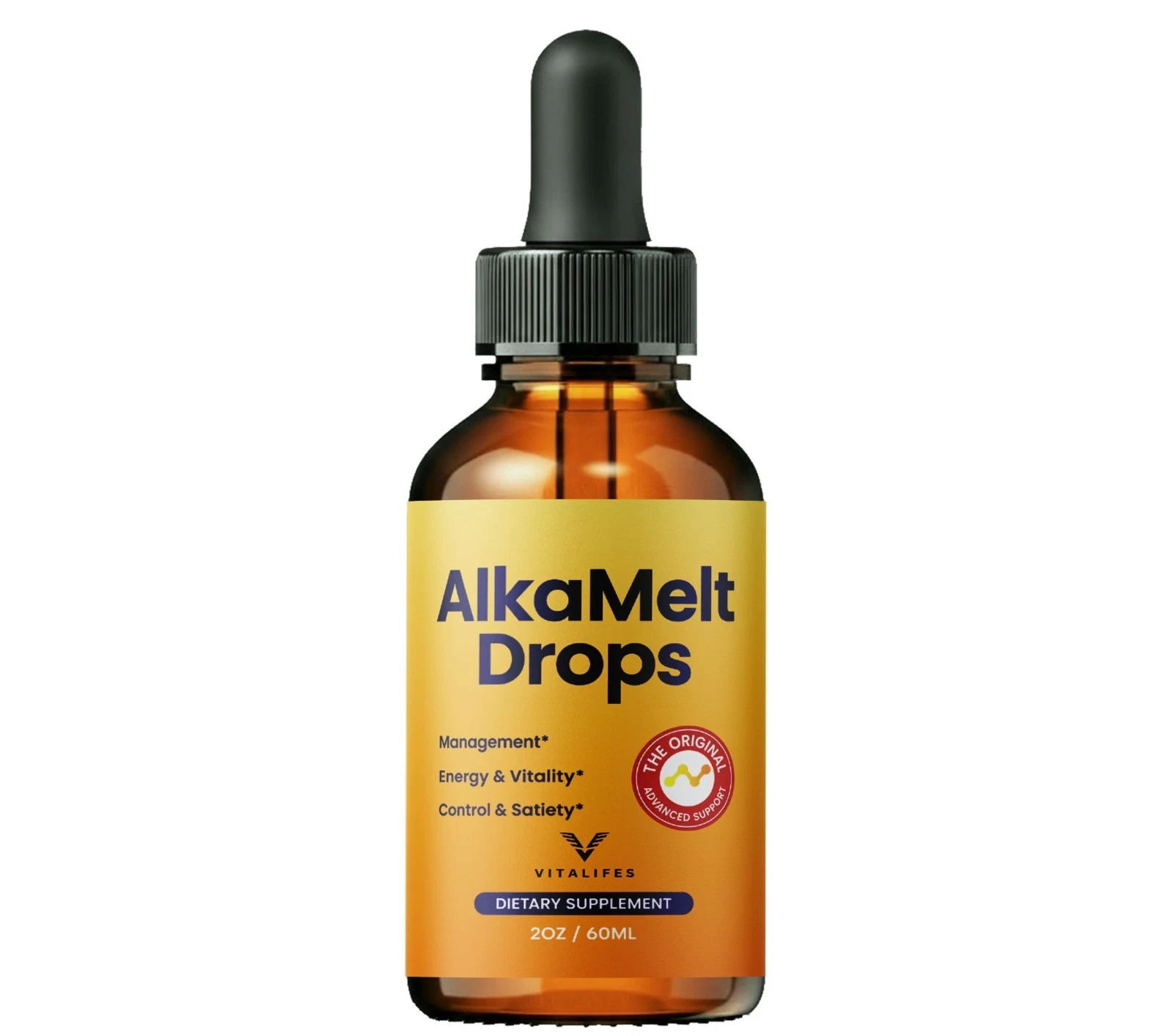
Everything readable on the Alka Melt Drops wrap is set out here
A transcription of the front label in the order it reads down the bottle, the four published ingredient lists, and the research behind each name. A 2 fl oz / 60 mL amber glass dropper bottle, price at the seller’s checkout.
Price at checkout · one-time payment · money-back guarantee as printed on the listing
Order Alka Melt Drops On The Official Website2 fl oz / 60 mL amber glass dropper bottle · lot ALK-26/TH-2256
The serving statement, and what it converts
This is the figure that does the most work on any liquid label, and it is worth understanding why.
A bottle of 2 fl oz / 60 mL is sixty millilitres. At a serving of one millilitre a day it lasts two months. At two millilitres it lasts one. At half a millilitre it lasts four. Nothing about the bottle distinguishes those three, and the difference between them is the whole of what a buyer is paying for.
It also converts a research dose into a practical question. Johnston’s vinegar dosing work used measured liquid volumes taken relative to a meal. Compare that to a serving statement and you can see in a moment whether a product is in the same territory or a different one entirely.
Where a label gives no serving, follow the bottle that arrives and nothing else. A figure read on a stockist’s website is a figure for a product that stockist may be describing from search results, and an analysis of labels in this category is a reminder that even a printed figure deserves reading twice.
The caution paragraph, and why it is last to be read and first to matter
It is the smallest type on most labels and it is the part with the highest chance of changing a decision.
Three things live in it. An age limit, which is almost always eighteen. An exclusion for pregnancy and nursing. And the interactions, which are the ones worth reading properly rather than scanning.
A controlled interaction study of hawthorn alongside digoxin is the example this desk points at most often, because it has an unusual second feature: hawthorn can also disturb the assay used to measure digoxin, so it can affect the test as well as the patient. That is exactly the kind of detail a caution paragraph exists to carry.
A review of supplement-associated liver injury makes the more general case. The interactions and cautions on a botanical label are not boilerplate, and the ones that matter are usually specific to a named plant rather than generic to the category.
The lot stamp, and the ten seconds it is worth
Stamped on the base or the shoulder, usually in small ink characters, and almost universally ignored.
It identifies the production run. If anything is ever wrong with a batch, that code is the only reference anybody will ask you for, and it is also how you check that the bottle in your hand is the one your order shipped.
Photograph it when the parcel arrives, next to the order email if you like. It takes ten seconds and it is the only step in this entire article that cannot be done retrospectively. The batch page covers what a matching lot does and does not establish.
Doing this in a shop, or in a browser tab
In a shop the whole exercise takes two minutes and needs nothing but the bottle. Online it is harder, and the difficulty is itself informative.
- Look for a photograph of the back. A seller confident about a panel photographs it. A listing with six angles of the front and none of the back has told you something.
- Zoom to full resolution. A panel that is legible at thumbnail size is rare; one that stays illegible at full size is usually not there.
- Check the seller’s own artwork against the sheet. Where marketing panels and specification documents disagree, believe the specification and note the disagreement.
- Search the product name with the word ingredients and read four results, recording who published each rather than merging them.
- Compare the leading ingredient’s trial dose to the bottle volume. Amounts are a well-studied problem, and physical impossibility settles questions faster than provenance does.
Four of those five are things a buyer can do before spending anything, and together they usually produce a clearer picture than the product page does.
When to put the bottle down
Three situations, and none of them is about the ingredients.
When you take a prescribed medicine and the caution paragraph names it, or names a class it belongs to. That is a conversation with whoever prescribed it, before the first serving rather than after a fortnight.
When the symptom you are buying for is new, getting worse, or arriving with pain. A supplement answers none of those and buying one is a way of postponing the question rather than settling it.
And when the label will not tell you what a serving is and no seller will either. That is not automatically a reason to walk away, but it is a reason to buy one bottle rather than six, read what actually arrives, and decide with the real label in your hand. The pricing page makes the same argument about the packs.
References
- Crawford C, Avula B, Lindsey AT, et al. Label Accuracy and Quality of Select Weight-Loss Dietary Supplements Sold on or near US Military Bases. Nutrients. 2024;16(24):4326. PMID 39770990. https://pubmed.ncbi.nlm.nih.gov/39770990/
- Johnston CS, Steplewska I, Long CA, et al. Examination of the antiglycemic properties of vinegar in healthy adults. Ann Nutr Metab. 2010;56(1):74-9. PMID 20068289. https://pubmed.ncbi.nlm.nih.gov/20068289/
- Tankanow R, Tamer HR, Streetman DS, et al. Interaction study between digoxin and a preparation of hawthorn (Crataegus oxyacantha). J Clin Pharmacol. 2003;43(6):637-42. PMID 12817526. https://pubmed.ncbi.nlm.nih.gov/12817526/
- Andrews KW, Gusev PA, Dwyer JT, et al. Dietary Supplement Ingredient Database (DSID) and the Application of Analytically Based Estimates of Ingredient Amount to Intake Calculations. J Nutr. 2018;148(suppl_2):1413S-1421S. PMID 31505677. https://pubmed.ncbi.nlm.nih.gov/31505677/
- Santos G, Gasca J, Parana R, et al. Profile of herbal and dietary supplements induced liver injury in Latin America: A systematic review of published reports. Phytother Res. 2021;35(1):6-19. PMID 32525269. https://pubmed.ncbi.nlm.nih.gov/32525269/